
A fascinating read on the “theft” of a national sport, and how the “People’s Shame” could be reversed.
Football has always been the people’s game, so how can we reclaim it from the corporations and oligarchs who have stolen it from us?
Micky P Kerr, in “Football, the People’s Shame”
Starting with an historical perspective on the (professional) game, and how its governance has diverged so far from the fans, Kerr presents a radical proposal to reclaim the game for the people, and a discussion of the political climate needed to facilitate such a radical change.
I am not an economist or a political scientist, so I don’t feel at all qualified to comment on Kerr’s proposals to reclaim the people’s game. Do read the book!
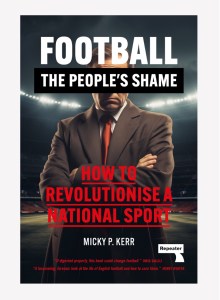
How to revolutionise a national sport
It is, indeed, a revolutionary proposal.
State nationalisation of the entire football industry, before setting it up under a Public-Common Partnership (PCP), co-ownership between appropriate state authorities and a Commoners Association. In this instance, that “Commoners Association” would be the collective fanbase of the clubs, essentially a mass membership.
The game would then fund itself by the sale of memberships and the creation of PCP-run breweries, lotteries, shirt manufacturing companies, and a worldwide broadcasting network.
Read the book for the calculations — they do look credible.
The People’s Game?
I do wonder a little about Kerr’s characterisation of the early game as “belonging” to the fans. Yes, the sense of connection inherent in soccer fandom, essentially local, exists, but the game has long been run by and for the club owners.
In Beastly Fury: The Strange Birth of English Football, Richard Sanders describes how control of the “people’s game” was wrested from the private school Old Boys clubs, who created the Football Association and the FA Cup competition, not by the clubs and their (professional) players, nor most certainly by “the people” (the fans), but by the owners of the new clubs founded in working class towns, by factory owners and brewers who saw the commercial opportunity offered by large working class crowds.
The professional takeover of the game was never really about local pride, or the glory (or not for very long, anyway).
It was about exploiting the working man’s newly won leisure time following the general introduction of the Saturday half-holiday (and, perhaps more pertinently, their disposable income).
Could it work?
Giving ownership to the people who actually care about the future of their clubs, of the wider game? Funding the game from the revenue it already generates?
Unrealistic? Simply too radical?
To take a single financial example.
Perhaps Todd Boehly has read Kerr’s thoughts on moving to just a single broadcast provider.
Not, in this instance, a publicly owned broadcasting (streaming) service, feeding profits back into the game, but a suggestion that this component of Kerr’s financial model might just be viable.
Would a “money man” even consider this option, if it could not make more money? Even as a Trump-ian “outrage”, an initial negotiating position designed to scare the existing broadcasters into bidding higher, it has to have some credibility.
Whither cricket? It can’t happen here…
Ironically, just as cricket in England & Wales prepares to sell itself to the highest bidder, Micky P Kerr presents his impassioned manifesto to reclaim “the People’s Game”, football, from “the corporations and oligarchs who have stolen it from us.”
Cricket in England has long held to its status as a “members’” game, from the top (MCC, who still write the Laws of the game, is a private members club) to the local cricket club (anyone can play…if they are a member, and registered on play-cricket.com…).
As described by Eric Midwinter in “Cricket’s Revolution – It’s Sudden Leap to Modernity” (published by Association of Cricket Statisticians & Historians), governance in cricket developed has long followed the “rational-legal authority” model (as defined by German sociologist Max Weber) prevalent in Victorian society — to prosper and thrive, society requires rules & laws (and committees to police those rule). So too for cricket.
There was never the shift from the traditional ownership to the “professional” classes that football experienced back in the 1880s & ‘90s. Nor the concept that the game of cricket ever really belonged to the “people”, however defined.
Clubs in the northern leagues, more progressive than the “clubbable south”, employed professional cricketers to draw the crowds on a Saturday afternoon, much as did the clubs in the Football League. But the prevailing attitude (and ultimate authority) in English cricket has always been Weber’s rational-legal — hierarchical, or the rule of the gentleman-amateur, as described by Duncan Stone in Different Class — The Untold Story of English Cricket.
Cricket belonged to the clubs, and the clubs were run by the committees. And, for all that club members had a vote, committees were run by strong characters, often pursuing their own vision of what was best for the club, and for the wider game.
And it is those committees that have now chosen to cash in their chips.
 The Teesra
What do you think? Leave a reply.