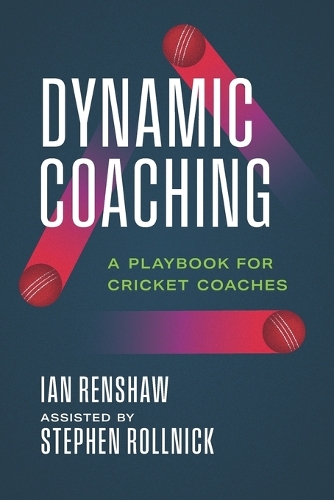
I have very much enjoyed reading Dynamic Coaching — A Playbook for Cricket Coaches by Ian Renshaw assisted by Stephen Rollnick.
Ian Renshaw’s presentations to the ECB Coaches Association Conference in 2017 were one of my earliest practical introductions to the constraints-led approach, and provided a justification of my own preference for games-based learning. I have been waiting for this book since then!
And I have not been disappointed.
With an emphasis on coaching in the “development” and “performance” spaces, Dynamic Coaching… achieves exactly what it sets out to do, offering a guide for cricket coaches looking to apply the theoretical approaches embodied in Ecological Dynamics and the constraints-led approach to skill acquisition.
The first chapter sets the tone — “A Different Way, with Fun Thrown In”. Dynamic Coaching is not the way any of us (coaches trained in the ECB’s Coach Education/Development system) will have been taught to coach.
It combines a practical application of a constraints-led approach to skill acquisition, as underpinned with Ecological Dynamics, with what (for me, at least) is an innovative take on genuinely player-centred coaching.
Motivational Interviewing, as advocated in Stephen’s contributions to the text, ensures that the player’s perspective is very much front-and-centre. The technique, described in detail in the text and associated (online) appendices, is central to achieving a genuinely athlete-centred approach.
Rehearsal
All the world’s a stage, and all the men & women merely players…
WILLIAM SHAKESPEARE (that well-known cricket coach)
(from As You Like It, spoken by Jaques)
The chapter on Rehearsal resonated with me. Yes, cricket, like the World, is just a game, so how better to prepare to play a role in that game than by rehearsing?
So the more realistic practice can be made, the better the rehearsal. Play a (short) game, find a “solution”; then play it again, but this time with a new solution. And repeat.
And a chapter on Gamifying Practice is exactly what I have craved in a coaching book. I certainly want to try out some “outrageous challenges” (pitched at level suitable for the players involved) — go on, buy the book!
Making it all happen
The practical sections of the book directly address several topics I have worried over: making net practice more realistic, and team fielding drills, in particular — I ran something very like “double play” for a while.
The section on Dynamic Coaching in Action comprises a suite of coaching case studies, with batters, bowlers and fielders. Including the player-coach transcript that preceded and directed the coaching & learning activities in the various scenarios really helps to illustrate the application of Motivational Interviewing.
Although I was slightly surprised to see every conversation ending with the coach-guru offering a solution — “I know what to do”/“here’s a game we can play”. Not quite Mosston’s “Self-Teaching” Style – K, where the learner makes all of the decisions about practice, with the coach as facilitator.
Practical, then Theory
I understand the rationale for pushing a lot of the theory (and even some of the practicals) into downloadable appendices, but found myself distracted by what goodies might be hiding in Appendices L, M, N & O…
Rob Ferley, from SquareOne Education, was kind enough to spend a little time shortly before Christmas, talking about the challenge of introducing Ecological Dynamics and the CLA to the wider coaching community. The language remains a barrier, I think, as do the theoretical foundations of ecological dynamics.
Leaving out the theory, or pushing it to the back of the book, or into downloadable appendices, is one approach.
No easy solutions.
Although I have just completed a short online training course on Practice Design hosted by UK Coaching, authored and presented by Dr Alex Lascu, that managed to engagingly cover a lot of the Ecological Dynamics/CLA space without actually using the words!
A way forward?
There is an intriguing section on the England Lions training camp in 2023 (within the chapter on Rehearsal, and in a lengthy Appendix L).
Featuring a range of learning environments and “game in the balance” scenarios,
Yes, a camp like this requires time and resources, perhaps including high quality net bowlers. But the potential benefits of personally tailored learning, specifically addressing some of the challenges anticipated in the next competitive cycle, would surely be well worth investing in.
And the next book, please…
In truth, this book, good as it is, does not quite match with my own area of practice. I am, for the most part, (proudly) a “kids coach”, but I am always looking for ways to play more & better games with them, and to build in opportunities for players to “learn how to learn”.
So what can I, as a children’s coach, do to introduce the players I work with to the benefits of curiosity in learning (always a challenge when we see them half an hour after the end of the school day)?
I do see this as a potential challenge to the wider application of Dynamic Coaching — are modern players (“kids today”) really receptive to this style of coaching? I appreciate that the inclusion of Stephen’s motivational interviewing techniques (skilfully applied by the coach) is designed to overcome any reticence on the part of the player.
But to me, this looks difficult!
I shall be re-reading the relevant Chapters and appendices, again and again.


 The Teesra
What do you think? Leave a reply.