In ‘lock ‘em up’, the batting team earn ‘upgrades’ (more open spaces to hit the ball into) by ‘locking’ fielders into disadvantageous fielding positions by successfully hitting the ball into designated target areas.
It is, in many respects, a gamified version of the old ‘Lord’s game’. I have played it only with a front foot drive, but I can see no reason not to adapt it to for other attacking strokes.
This game has developed from an idea shared by @imsporticus , modified to include concepts from @davidhinchliffe and @ianren21 — thanks to all of my fellow coaches for the inspiration, and also to @AmyPrice_10 et al. for the theoretical underpinnings of sports coaching informed by digital game design.
Lock ’em up – how it works
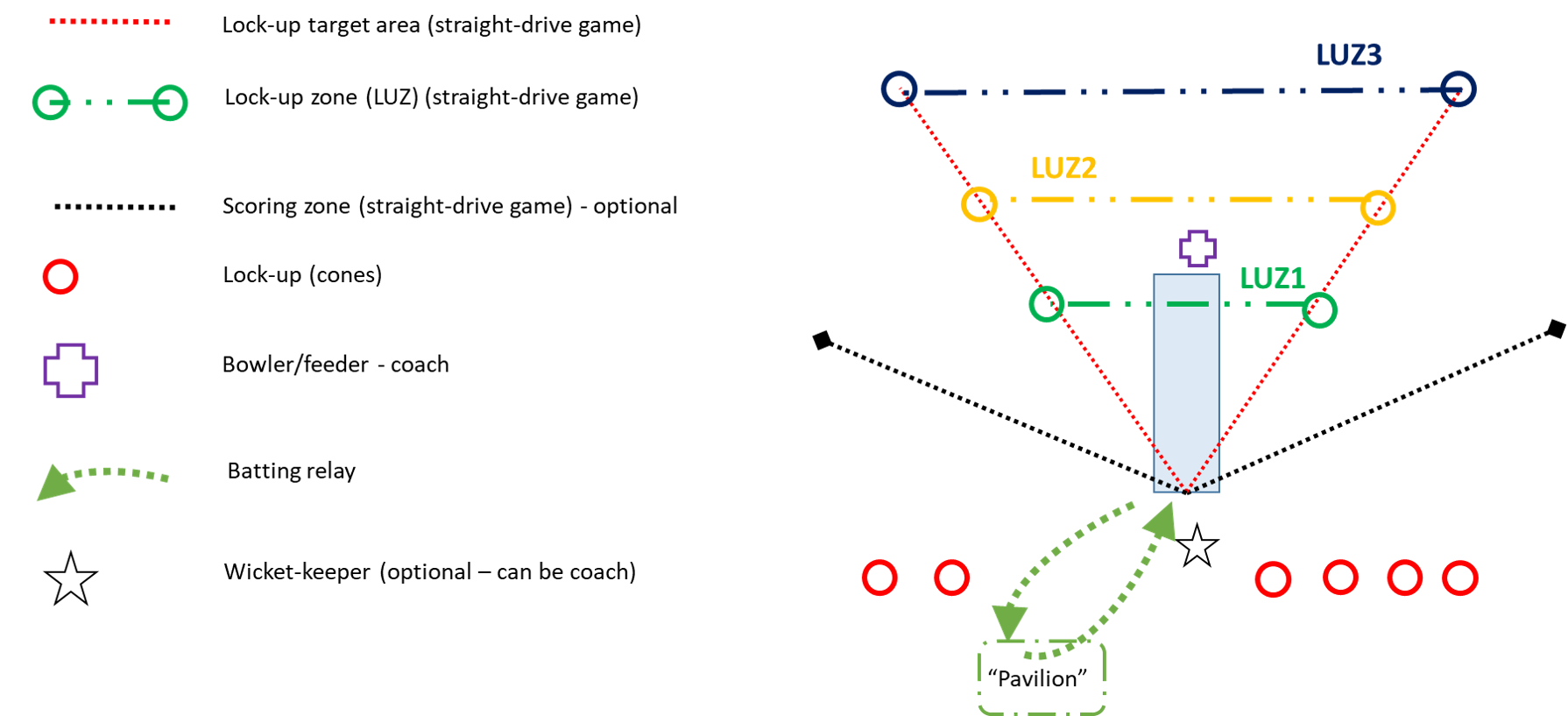 Playing the game
Batters are challenged to drive the ball straight down the ground.
It might be best to have the coach feed the ball, or to allow a ‘co-operative feed’ from a teammate, to ensure that the batter receives deliveries that give him at least the chance to play a front foot drive.
Batters receive a set number of deliveries (3-6 seems to work, depending on the number of players in each team, and how patient they are whilst waiting their turn to bat).
Batters do not have to run every ball, but they score runs only by hitting the ball into the appropriate scoring zone (either restricted to the lock-up zones, or extended on either side) and running, and/or by clearing a boundary line, if there is an adequate space available.
Lock up
Hit the ball over the first target line (into the first lock-up zone (LUZ1), designated by cones), and the batting team get to ‘lock up’ a fielder – the fielder has to be “in the lock up’ (touching the designated cone) until the batter strikes the next delivery.
Hitting the ball beyond the second target line (LUZ2) locks up two fielders; beyond the third target line (LUZ3) and three fielders will be locked.
Fielders are locked until the next batter comes in OR for the duration of the team innings (so subsequent batters start with some locked fielders) — coach’s choice.
If a batter is bowled or caught out, all locked fielders are automatically released.
Other options
- LUZs can be set closer to the batsman, or further away, depending on the batters’ ability to hit the target
- If a batter is run out, they lose the ability to lock up fielders for the rest of their innings/for the next delivery
- so that there is a consequence for poor running or good fielding [this suggested by the u11 players I tested this game with]
- Batters in pairs
- more representative; run outs at both ends [again, suggested by the u11 group]
- Batters can score from shots hit outside the target area
- depends on the number of fielders (more fielders could effectively block the LUZ, so batters might need more scope to score runs outside the LUZ), and the ability of the batsmen to hit into the designated LUZ.


What do you think? Leave a reply.